


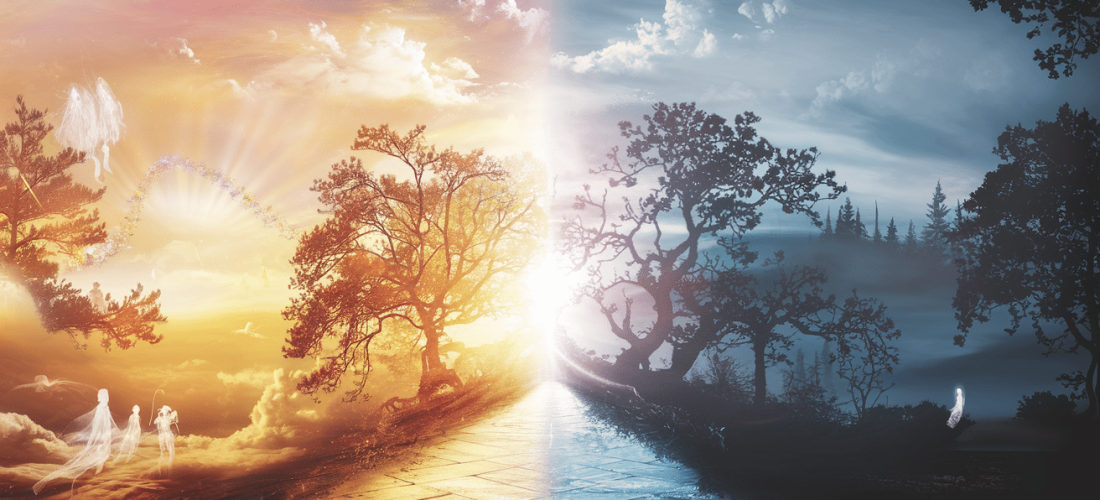
The question of where do we go after death is universal and timeless. It arouses curiosity and reflection, touching on deep themes of spirituality and metaphysics. This article aims to explore various viewpoints on our destiny after this passage, inviting introspection on our existence, our beliefs, and our relationship with the beyond.
Table of Contents
ToggleBeliefs through time
For centuries, human beings have been asking questions about the afterlife. Many cultures have tried to explain the phenomenon of death and what happens afterward. For some spiritual traditions, the soul is different from the physical body. It continues its journey and still learns after death. For others, death is a simple passage to another state of consciousness or a return to the universe. Eastern philosophies, such as Hinduism and Buddhism, evoke reincarnation, a rebirth of the soul in a new body. This cycle may seem burdensome, but it is also seen as an opportunity for learning and purification.
On the other hand, Abrahamic religions such as Christianity, Judaism, and Islam offer very diverse visions but often focused on a final judgment and a reward or punishment, depending on the actions taken during life. These beliefs reinforce the idea of ethical responsibility in daily decisions, while often encouraging spiritual preparation for death.
Understanding these different perspectives can help us see the destiny after death not as something fixed, but as a journey that depends on our conduct here below.
The soul and its journey
When discussing the soul, it is essential to understand that its journey after death is not uniform. Each soul is unique and its post-mortem experience is influenced by the life it lived. Here are some aspects to consider:
- Transition : Many souls experience a period of transition. They may stay attached to this world for various reasons, such as farewells not made or regrets.
- Aware realization: Some souls become aware of their departure when they witness their own funerals. This experience can be disturbing, but it also offers the opportunity to reflect on life.
- Interactions: Souls may try to communicate with those who remain. Subtle signs, such as shared memories or dreams, are often reported by those who lose a loved one.
These elements lead to reflections on the persistent link between the living and the deceased.
The journey of a soul is not linear. Some individuals report experiences of traveling towards a radiant light, often interpreted as a form of judgment or purification. At this stage, souls are assisted by spiritual guides to reconsider their life, examine their past actions, and prepare for possible reincarnations.
Lost souls
Another dimension to explore is that of so-called “lost” souls. This concept refers to souls that hesitate to leave this world for various reasons, whether linked to attachment, fear of the unknown, or a feeling of guilt. In many stories, these souls can wander aimlessly, sometimes long after their death.
Many testimonies speak of souls that could not leave the earthly plane when they felt guilty or unhappy about events in their existence. A loved one may not have had the opportunity to say goodbye, causing the deceased to be highly sensitive to these relationships, thus holding them back. For these souls, it can be beneficial to be accompanied, whether by relatives or soul guides.
Spiritual help can offer them an opening to understand their situation and realize that they have the right to *let go*. There are several approaches to help these souls in their transition. Rituals, communication sessions, or meditation can help release them from their shackles.
Steps towards the light
Just as life is marked by stages, death and the beyond are as well. This path towards the light often begins with introspection following the life lived. Fascinating, isn’t it? Souls will review their deeds, benefiting from a benevolent yet critical view of their existence. During this phase, it is entirely normal to experience intense emotions, ranging from sadness to acceptance. Each realization allows the soul to evolve and purify what it has experienced.
This introspective phase often takes place with the help of beings of light, spiritual entities who guide souls on their path. These beings allow the soul to feel safe and accepted and to address often unresolved elements of its life. Encounters with loved ones may also appear, bringing comfort and a space for healing. The presence of so many benevolent entities reminds us how *sacred* and helpful love is.
Reincarnation and its mysteries
The notion of reincarnation sparks a lively debate among believers and skeptics. For some, this idea represents the hope of a new chance to progress, redeem oneself, or learn. The soul reincarnates in a new body, in a different world, with lessons to memorize and other challenges to face.
Stories of reincarnation often come from accounts of children who recall memories of past lives. These testimonies, although unusual, raise profound questions about identity and the continuity of the soul. It is even possible that, from one life to another, certain traits, fears, or talents persist. How else to explain these reminiscences if not through spiritual continuity?
Thus, the experience of reincarnation reveals itself as a remarkable tool for personal evolution. Each existence becomes a step towards a more comprehensive understanding of human nature and relationships. From this dynamic arises an insatiable curiosity to discover the meaning of our life and the lessons we must learn.
Life beyond
In a metaphorical framework, thinking about the afterlife can evoke both fear and fascination. Beyond the material existence and daily struggles, *life after death* could represent a freedom of the soul, a connection with a higher plane of existence. The experiences and accounts reported by those who have had near-death experiences often testify to a journey towards unparalleled harmony and tranquility.
When exploring these concepts, it is essential to keep an open mind. Death, although perceived as an end, could also symbolize a rebirth towards infinite possibilities. In this regard, spirituality, in its many facets, is a path that each individual can explore in their own way, thus strengthening a dialogue around the beliefs and values underpinning our existence.
Open questions about the afterlife
As we navigate the intricacies of spirituality and the meaning of life, the question remains: where do we really go after death? This universal question urges us to contemplate not only the beliefs of others but also those we hold within ourselves. Perhaps each perspective, whether spiritual, scientific, or personal, is a facet of a larger puzzle that we must decipher.


