


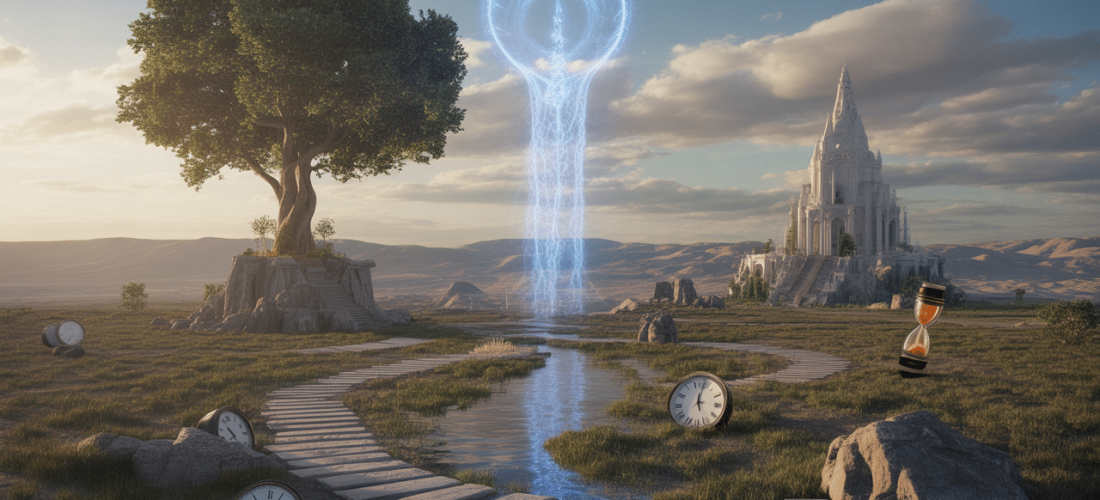
The question of the time the soul spends on Earth after death has fascinated and intrigued for centuries. It touches not only on our understanding of what happens after this existence but also on our relationship with life and death. At the heart of this spiritual quest, beliefs and theories emerging from different and varied cultures and traditions reveal a range of fascinating perspectives. The diversity of views regarding the duration of the soul’s stay gives rise to rich dialogues, between the mysteries of existence and personal exploration.
Table of Contents
ToggleReligious beliefs concerning the soul and its stay on Earth
Religions around the world offer distinct perspectives on the length of the soul’s presence after death. In some traditions, the soul is seen as a spiritual journey, eternal and evolving. Take the example of Christianity, which teaches that the soul is judged immediately after death. Believers state that it is directed to heaven or hell depending on the actions performed during its earthly life. This raises questions about the notion of transcendence and the time needed for each soul to assess its choices.
Other traditions, such as Hinduism, teach that the soul faces a process of reincarnation. According to this belief, the soul may spend some time in an intermediate plane before reincarnating. This time lapse depends on multiple factors, notably the spiritual evolution state of the soul. Thus, one might speak of the wandering soul navigating between different dimensions before making its next passage on Earth.
| Religion | Perspectives on the soul’s stay |
|---|---|
| Christianity | Immediate judgment, heaven or hell |
| Hinduism | Reincarnation after an intermediate stage |
| Buddhism | Life cycle, death and rebirth without precise temporal determination |
| Islam | Waiting in the grave until the Day of Judgment |
| Indigenous traditions | Life cycle, dialogue between the living and spirits |
In Buddhism, the emphasis is on the cycle of life and death without a fixed temporality. The soul can pass through several lives and testimonies until reaching enlightenment. Each existence is an opportunity to learn and evolve. This concept invites reflection on the meaning of spiritual wandering, and how much accumulated experiences shape our soul through incarnations.
Within Islam, the soul waits in the grave until the Day of Judgment, which implies another perspective on time. This decisive moment carries meaning and could be compared to a period of evaluation of earthly life. The souls of the deceased may be called to work alongside the living beings, thus reaffirming a connection between dimensions.
Indigenous traditions, for their part, often see the soul as being in constant dialogue with the living. The duration of its stay is marked by rituals that establish Calling Protocols. The soul might wander around its last environment, watching over the kindness of its relatives and guiding the living toward an understanding and recognition of their spiritual heritage. The Land of Life then becomes a sacred ground where the echoes of souls continue to influence the present.
Scientific and psychological implications on the soul’s stay
While the spiritual dimension is predominant in certain traditions, the question of the duration of the soul’s stay on Earth also encounters a scientific and psychological perspective. In the field of consciousness and psychology, numerous studies address near-death experiences (NDEs), enriching the debate on the nature of the soul and its persistence after death. Some researchers suggest that the spirit continues to operate in a certain space-time after clinical death in a process where the soul would still be connected to its body, blurring the boundary between life and death.
Reports of near-death experiences shed fascinating light on the perception of time beyond life. Testimonies from individuals who have experienced NDEs often mention sensations of floating, unity with the universe, and recognition of familiar faces. These experiences challenge our understanding of the mystery of existence and the nature of time when perceived through a spiritual lens. How does the human brain interpret these moments of suspension, and what can they reveal about the consciousness of the soul?
| Element | Description |
|---|---|
| Near-death experience | Testimonies from individuals who lived an experience at the threshold of death |
| Temporal flow | Perception of a slowing down or extension of time |
| Meditative state | Psychological state favoring a deeper connection with the soul |
| Neurobiological reactions | Chemical effects on the brain approaching death |
Another dimension to consider is the notion of consciousness quest, which raises questions about how our mind transforms when facing out-of-body experiences. Some theories propose that the soul can detach from its material aspect and travel beyond the temporal limits established by our reality. Thus, the soul’s stay could be a timeless journey, extending beyond earthly laws. What would this imply for our approach to daily life? It suggests that the search for meaning and human experience is not limited to physical existence.
In addressing these questions, it is important to break the silence surrounding conversations about death and consciousness. Through meditation workshops, conferences on near-death experiences, or even spiritual retreats, many individuals feel the need to connect with this higher dimension of their existence. The call to deepen the knowledge of the soul and transformative time is growing.
The duration of the soul’s stay through cultural narratives and mystical phenomena
Cultural narratives and mystical phenomena greatly enrich the notion of the duration of the soul’s stay after death. Numerous myths, legends, and stories shape our understanding of this universal question. In African cultures, for example, the soul is often perceived as an entity that continues to influence the community of the living. The elders gather to honor their ancestors, firmly believing that their wandering soul watches over them.
Stories such as that of Osiris in ancient Egypt highlight the importance of the afterlife and death, maintaining that lost souls remain in a resting state before being judged. This mythological representation shows how societies integrate spiritual beliefs into their collective culture. Once again, the notion of time seems to merge into a space that could be called the “afterlife,” which requires a more nuanced understanding.
Many funeral rites also testify to the importance given to the presence of the soul on Earth. Traditions such as the Día de los Muertos in Mexico celebrate the return of souls within families, marking a celebration where life and death converge. This festive vision shows that the soul is not simply considered as an entity drifting toward oblivion but as a living actor in shared existence. These testimonies weave a network of beliefs and practices that enrich the understanding of souls after life.
| Culture | Belief and practice |
|---|---|
| Egyptian | Funeral rites, judgment of Osiris |
| African | Ancestor honoring and community rites |
| Mesoamerican | Celebration of the dead at Día de los Muertos |
| Indian | Ending rituals and reincarnation |
These cultural riches evoke how souls maintain operative and resonant ties with their living. Thus, they participate in a spiritual journey, where time and space converge in pristine dimensions of understanding. The soul lives through stories, traditions, and memories, also shaping the collective consciousness of societies to come.
Experiences and testimonies on the soul’s stay
Individual accounts of personal experiences regarding the soul’s stay provide a unique perspective on this subject. Many individuals share captivating stories of interactions with spirits, apparitions, and sensations of presence from the deceased. These testimonies reinforce the idea that the presence of the soul does not dissipate immediately after death but can persist long in collective memory and significant places.
Individuals report moments where they felt a spiritual connection with departed loved ones, whether in dreams or in their daily lives. Sometimes, manifest signs such as moving objects, temperature changes, or strange coincidences (symbolic reunions) come to strengthen this connection. These manifestations illustrate the indelible bond between the living and souls, suggesting that time can be an elastic concept in the spiritual domain.
| Type of testimony | Description |
|---|---|
| Paranormal events | Manifest signs after death, inexplicable coincidences |
| Dream visits | Dreams where the deceased appear to bring messages |
| Funeral rituals | Enhancing spiritual connection with departed souls |
| Mediumistic communications | Messages transmitted by mediums through souls |
These interactions are further enriched by a framework of meditation, rituals, and spiritual explorations. For example, the practice of energy healing might help improve the connection with the soul’s dimensions, offering a space for an authentic dialogue. By fostering exchanges with the invisible, this not only provides comfort but also a rediscovery of the bonds that unite souls to the living.
In sum, the accounts of many people reaffirm that the question of the soul’s stay and the time surrounding it is much more than a simple inquiry. It is a profound exploration of spiritual dimensions, collective beliefs, and an interconnected journey that influences our relationship with existence.


