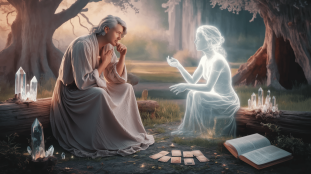
The soul’s journey through the mysteries of the afterlife is a subject that has fascinated humanity for centuries. By delving into the accounts of those who have approached the beyond, spiritual traditions, and ancestral knowledge, one discovers a vast panorama of the celestial destinies that await every traveling soul. This article explores unknown dimensions of this invisible reality, thus drawing attention to the promises of an endless existence and the profound spiritual revelations that arise from it.
Table of Contents
ToggleBeliefs at the crossroads: duality between life and death
Life and death are often perceived as two opposing states, but for many cultures, they intertwine in an eternal journey. In several traditions, death is not considered an end, but a transformation, a passage to another state of existence. This concept finds its roots in Eastern philosophies, where the cycle of reincarnation lies at the heart of beliefs.
Wandering souls are often mentioned in ancient and modern stories. According to these beliefs, they return to accomplish unfinished missions or to help the living through difficult trials. In this context, death becomes an opportunity for learning and spiritual growth.
Rites of passage in different cultures
Funerary rites testify to how different societies perceive the passage to the beyond. Here are some striking examples:
- Celebrations in Africa: In many African cultures, death is marked by colorful festivities. Ancestors are honored with songs and dances that celebrate their return to the spiritual world.
- Rites in South America: Andean traditions maintain that souls continue to exist in a parallel world. Celebrations such as Día de los Muertos in Mexico recall their presence within daily life.
- In Asian traditions: Practices such as cremation are found, which is viewed as an act of liberation, allowing the soul to rise and begin its new journey.
These various rituals show the rich tapestry of beliefs surrounding death, highlighting the respect and connection that the living maintain with the beyond.
Near-death experience (NDE) testimonies
Near-death experiences are accounts shared by those who have flirted with death and returned. These testimonies often evoke visions of an intense light, encounters with deceased loved ones, and a sensation of unconditional love. These accounts, coming from different cultures and contexts, open a window on the invisible explorations of the soul.
Scientific studies on these experiences highlight common elements, such as a feeling of peace or the absence of pain. Some researchers suggest that these experiences could play a crucial role in understanding our consciousness and spiritual essence. Thus, the travelers of the beyond also become teachers for those who remain, guiding toward deeper acceptance of death as a passage.
Contemporary theories about the beyond
Contemporary science and spirituality are beginning to find fascinating intersections. Neuroscience explores consciousness with an approach that questions the notion of a linear existence. Discoveries about the functioning of the human brain, particularly concerning consciousness, suggest that a part of it might persist even after death.
Researchers such as Dr. Eben Alexander, a neurosurgeon, share their spiritual journeys after being in a prolonged coma. His revelations highlight a transcendent journey where he felt deep love and a universal connection, which leads him to propose that consciousness could exist independently of the physical body.
The implications of scientific discoveries
Advances in quantum physics and neuroscience can disrupt our current understanding of the soul and death. Here are some significant aspects:
- Quantum physics: Some theories suggest that the human mind could influence physical reality, thereby redefining the boundaries between matter and spirit.
- Consciousness studies: The field of neuroscience reveals that human consciousness could transcend usual states, opening the way to new perspectives on the soul.
- Research on communication with the dead: Studies explore the possibility of spiritual interactions through channels such as mediums, thus deepening the link between the physical and spiritual worlds.
These discoveries reinforce the notion that the soul has a celestial destiny, aligning with ancient and contemporary beliefs about the afterlife.
Spiritual revelations throughout history
Humanity has always sought to understand what lies behind the veil of death. Sacred books and spiritual traditions are filled with reflections on this mystical subject. In different cultures, sages and mediums have been called upon to share their visions concerning the spiritual world.
Spiritual revelations are often captured in ancient texts that guide souls on their journeys. For example, in the Christian tradition, the Egyptian Book of the Dead offers a depiction of the trials the soul must pass after death, while Buddhism proposes the Bardo Thodol, which describes the intermediate states between life and rebirth.
The wisdom of the ancestors: timeless messages
The teachings of the ancestors continue to resonate through the ages. Whether through legends, tales, or proverbs, these messages offer profound understanding of spiritual truths.
Indian traditions, for example, speak of the importance of living virtuously to ensure a favorable rebirth. Thus, souls are encouraged to evolve on their soul path, in order to acquire wisdom and compassion.
At the same time, Native American tradition teaches that every living being is connected. This vision encourages deep respect for life, integrating the idea that every action has consequences on the cycle of life and death.
Practical implications for the living
Understanding the soul’s journey brings a level of comfort to those going through losses or major transitions. Awareness of an endless journey greatly helps restore a bond with deceased loved ones. This consciousness also promotes more respectful behavior towards oneself and others.
The search for meaning following a loss often translates into altruistic behaviors or spiritual commitments, transforming personal suffering into collective strength. The experiences of people who have communed with invisible worlds show how much the dialogue between the living and the beyond can enrich our existence.
Practices to honor the other side
For those seeking to connect with their ancestors or to prepare their own journey, various practices can prove beneficial:
- Meditation: Taking time to meditate allows establishing a link with the spiritual aspect of existence, thus facilitating contact with the beyond.
- Memorial rituals: Organizing ceremonies in memory of loved ones helps establish a bridge between worlds, fostering healing and peace.
- Spiritual conversations: Sharing experiences and beliefs about death encourages a broader understanding of the soul’s journey.
These practices invite us to redefine death, not as a separation but as a phase of transformation toward unknown horizons.